The Lab / Research.
What is audiovisual stimulation? How light and sound influence brain rhythms
You can measure almost everything about yourself now. Sleep stages, heart rate variability, recovery scores, strain. A decade of wearables taught a generation to read its own physiology in high resolution.
What none of it answered is the question that comes next. You know you are wired at 11pm. You know your recovery is poor before an important morning. Knowing does not change it.
That gap is where a category called audiovisual stimulation sits. It has been studied in laboratories for decades, and it is only now arriving in a form built for daily life. This article explains what it is, how it is thought to work, what the research currently supports, and what it does not.
What audiovisual stimulation is
Audiovisual stimulation, commonly shortened to AVS, delivers rhythmic light and sound at the same time. These coordinated sensory patterns are designed to interact with the brain’s natural rhythmic activity.
In practice that usually means pulses of light delivered through closed eyelids, paired with tones delivered through headphones, both timed to a specific frequency. The light and the sound are not decoration around a meditation track. The timing is the active part.
You will also see the technique called audio-visual entrainment (AVE), photic and auditory entrainment, or light and sound stimulation. The terminology varies between research groups, which is one reason the field can be difficult to read from the outside.
AVS is a research-supported approach that uses coordinated light and sound to interact with patterns of brain activity. It is not a treatment, and it is not a medical intervention when delivered as a consumer wellness product.
How rhythmic light and sound interact with brain activity
Your brain produces continuous patterns of electrical activity. Those patterns change measurably depending on whether you are alert, relaxed, drowsy, or asleep. They have been recordable since Hans Berger published the first human electroencephalogram in 1929, which makes the study of human brain rhythms very nearly a century old.
When the visual system receives a steady rhythmic input, the electrical response follows it. This is one of the most reliably reproduced findings in sensory neuroscience. In a well-known experiment, participants were shown flickering light across the full range from 1 to 100 Hz in single-hertz steps. Steady-state responses appeared at essentially every frequency tested up to around 90 Hz, and the response was noticeably stronger at some frequencies than others, with clear peaks near 10, 20, 40, and 80 Hz (Herrmann, 2001).
That measurable following response is called a steady-state visually evoked potential, or SSVEP. It is the clearest evidence that the brain is genuinely registering the rhythm rather than the person simply relaxing because they expect to.
The step from “the visual cortex tracks the flicker” to “the person feels calmer” is a longer one, and it is where honest description matters. A measured response to a stimulus is not the same thing as a guaranteed change in how someone feels. Both things can be true at once: the response is real and measurable, and the downstream experience varies between people.
How AVS differs from meditation, white noise, and light therapy
Meditation asks you to do the work. You direct attention, notice, and return, often at the exact moments you are least able to. It is a trained skill with real evidence behind it. AVS asks nothing of you procedurally. You put it on and the stimulus does the timing.
White noise and ambient sound mask environmental noise and can make an environment feel calmer. They are broadly unstructured by design. AVS is defined by its structure: specific frequencies, delivered at specific times, in a specific sequence.
Standalone light therapy, such as a bright light box for seasonal low mood or circadian timing, works primarily through light intensity and time of day. It is about how much light and when. AVS is about how the light is timed, rhythmically, along with matched sound.
Binaural beats are the closest relative. They are an auditory-only technique, and the evidence for them is less consistent than many product pages suggest. A 2023 systematic review looking specifically at whether binaural beats measurably change brain oscillatory activity found the results across studies to be mixed and difficult to reconcile (Ingendoh, Posny & Heine, 2023). AVS differs by adding a visual channel, which produces a considerably more robust measurable response than sound alone.
What current research suggests
Researchers have explored AVS in relation to sleep, self-reported mood, stress, and cognitive performance. Some studies have reported encouraging findings, although results can vary depending on the protocol, population, and study design.
The most useful summary of where the field actually stands is a 2025 structured review published in Brain Sciences, which surveyed the technical parameters, delivery methods, reported applications, and safety considerations of audiovisual entrainment. Its conclusion is worth quoting in spirit rather than dressing up: the findings across the literature are heterogeneous, including null and limited results, mechanistic understanding remains underdeveloped, and premature claims of efficacy are not warranted (Rahmani, Romero Lauro & Pisoni, 2025).
An earlier and frequently cited review of 20 brainwave entrainment studies reported effects across cognition, stress, pain, and mood (Huang & Charyton, 2008). It is worth knowing that an independent quality appraisal of that review flagged limitations in the controlled evidence and reporting available at the time, which is a fair reason to treat it as directional rather than conclusive.
So the accurate position is this. The mechanism is real and measurable. The parameter space is large and under-standardized. The outcome literature is promising in places and thin in others. Anyone telling you the category is settled science is selling something, and anyone telling you nothing is happening has not looked at the EEG data.
We would rather say that plainly than overstate it. The claims a company can defend are worth more than the claims it can make.
Why this is arriving now
If the mechanism has been studied for decades, the obvious question is why these devices are only reaching people now. The answer has little to do with new science.
Three things changed at once. The components got good and cheap: precise LED timing, comfortable optics, and decent audio in a wearable form factor were expensive and awkward twenty years ago. Measurement culture changed: a decade of wearables taught a very large number of people to take their own physiology seriously, which created an audience that had never existed before. And expectations of design changed. The laboratory versions of these devices were built for researchers and looked like it. Nobody was going to put one on every night.
What was missing was never the effect. It was an instrument worth reaching for, and a reason for anyone outside a lab to care.
How Domayn approaches AVS
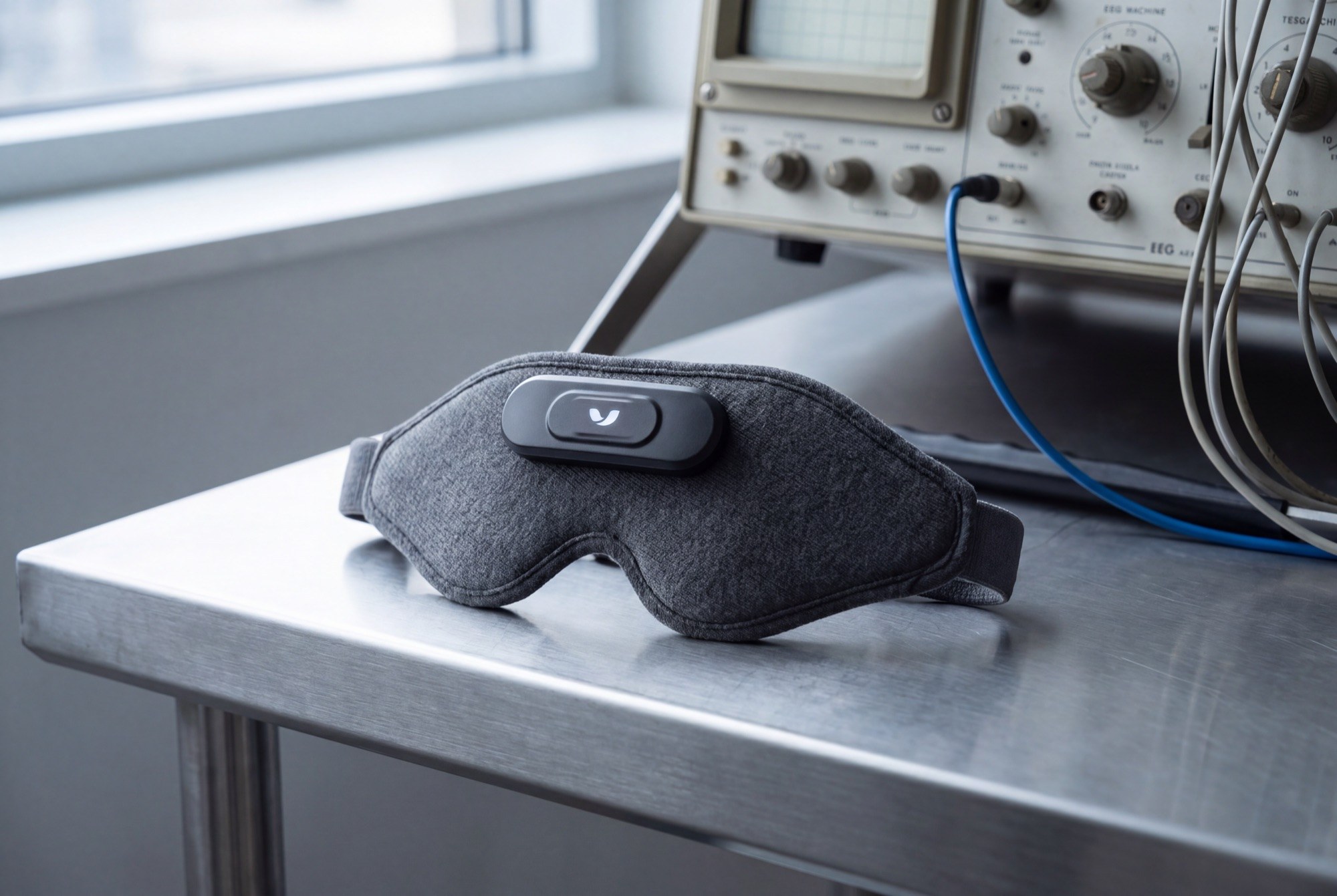
Domayn applies audiovisual stimulation through coordinated light and sound delivered using a mask and headphones. Its protocols are designed around specific session goals and everyday use: Wake, Focus, Relax, and Sleep. Sessions run five to fifteen minutes.
The design position is narrower than the marketing in this category usually is. The Mask is a consumer wellness product, not a medical device. It is not intended to diagnose, treat, cure, or prevent any condition. It does not read your physiology or adapt to it, and it does not replace the tracker you already wear. Where a tracker reads your state, the Mask is what you do next.
Different nervous systems respond differently to rhythmic stimulation, which is why there are four protocols rather than one universal setting.
read what the science does and does not support
Who should be cautious with AVS
Because AVS involves rhythmic light, it is not suitable for everyone.
The Mask is not suitable for people with photosensitive epilepsy or a history of seizures triggered by flashing lights. As with any light-based device, a small number of users may experience mild, temporary discomfort including headache or eye strain. If you experience any adverse symptoms during or after use, discontinue use and consult a healthcare professional. If you have a medical condition, are pregnant, or are taking medication, consult your healthcare provider before use. This product is not a medical device and is not intended to diagnose, treat, cure, or prevent any disease or medical condition.
Always follow the instructions supplied with any light-based device, and seek medical guidance where relevant.
Where this leaves you
Audiovisual stimulation is a real mechanism with a developing evidence base, not a finished science and not a gimmick. The measurable brain response to rhythmic light is one of the better-replicated findings in sensory neuroscience. What that response produces in daily experience is a more open question, and one the field is still working on carefully.
If you want the mechanism explained properly, the next article covers neural entrainment: what it is, and what it is not. For where AVS sits alongside clinical technologies, see non-invasive neuromodulation.
Feel Different.
Frequently asked questions
What is audiovisual stimulation?
Audiovisual stimulation, or AVS, delivers rhythmic light and sound at the same time, timed to specific frequencies, in order to interact with the brain’s natural rhythmic activity.
How does audiovisual stimulation work?
Rhythmic light delivered through closed eyelids and matched tones delivered through headphones produce a measurable following response in the brain’s electrical activity. This is recordable on EEG as a steady-state response. How that response translates into subjective experience varies by protocol and by individual.
Is AVS the same as light therapy?
No. Light therapy works mainly through the intensity and timing of exposure, for example a bright light box used in the morning. AVS works through the rhythmic timing of light pulses paired with sound.
Is AVS the same as binaural beats?
No. Binaural beats are audio only. AVS adds a synchronized visual channel, which produces a stronger and more consistent measurable response than sound alone.
Who should avoid flashing light stimulation?
Anyone with photosensitive epilepsy or a history of seizures triggered by flashing lights should not use light-based stimulation devices. If you have a medical condition, are pregnant, or take medication, consult your healthcare provider first.
References
- Berger, H. (1929). Über das Elektrenkephalogramm des Menschen. Archiv für Psychiatrie und Nervenkrankheiten, 87, 527–570.
- Herrmann, C. S. (2001). Human EEG responses to 1–100 Hz flicker: resonance phenomena in visual cortex and their potential correlation to cognitive phenomena. Experimental Brain Research, 137(3–4), 346–353. doi.org/10.1007/s002210100682
- Huang, T. L., & Charyton, C. (2008). A comprehensive review of the psychological effects of brainwave entrainment. Alternative Therapies in Health and Medicine, 14(5), 38–50.
- Ingendoh, R. M., Posny, E. S., & Heine, A. (2023). Binaural beats to entrain the brain? A systematic review. PLoS ONE, 18(5), e0286023. doi.org/10.1371/journal.pone.0286023
- Rahmani, M., Romero Lauro, L. J., & Pisoni, A. (2025). Audio-Visual Entrainment Neuromodulation: A Review of Technical and Functional Aspects. Brain Sciences, 15(10), 1070. doi.org/10.3390/brainsci15101070