The Lab / Research.
What is neural entrainment? How the brain responds to rhythm
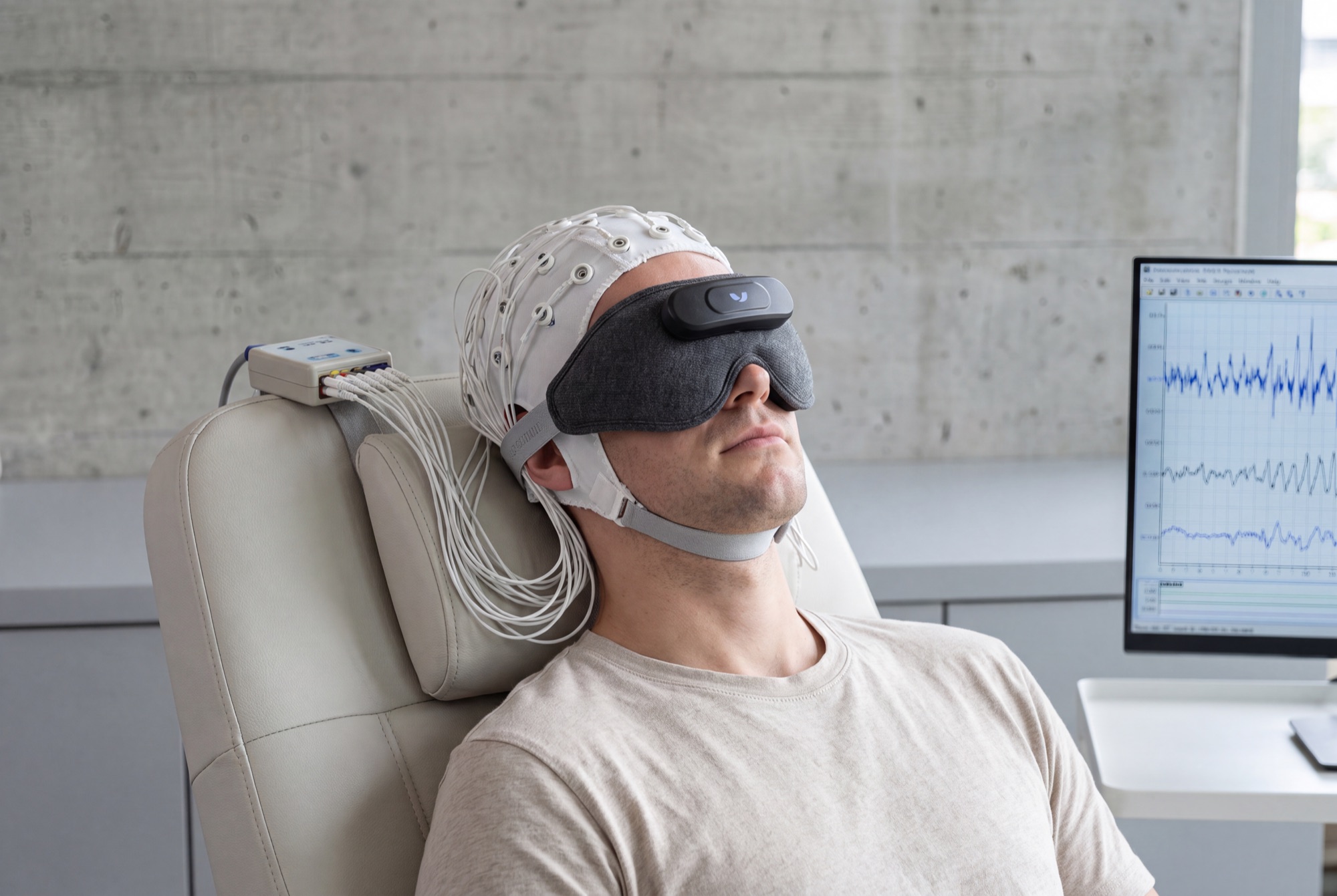
Your brain is built to follow rhythm.
You have felt a version of this. A song comes on and you are nodding before you decided to. A room falls into step with a beat. Rhythm is one of the oldest inputs a nervous system has learned to track, and it does not require your permission or your attention to do it.
Neural entrainment is the formal name for a version of that effect, measured at the level of the brain’s own electrical activity. It is the mechanism underneath audiovisual stimulation, and it is worth understanding properly, including its limits.
What neural entrainment means
The brain continually responds to patterns in the environment. Under certain conditions, rhythmic sensory input can influence the timing or strength of neural activity. This process is commonly described as neural entrainment.
Read that definition carefully, because the wording is doing real work. It says can influence, not will control. The brain is not a passive instrument that plays whatever frequency you feed it. It is a system with its own ongoing rhythms, and external rhythm interacts with those rather than overwriting them.
This is the single most common place popular writing about the topic goes wrong. The claim “play a 10 Hz tone and your brain goes to 10 Hz” is a caricature. The accurate version is that rhythmic input produces a measurable response that can bias activity toward the stimulus frequency, with the size and reliability of that effect depending on the frequency, the channel, the protocol, and the person.
How rhythmic sensory input influences brain activity
Think of a tuning fork near a stringed instrument. Strike the fork and a string tuned to the same note will begin to sound, because it responds most readily to energy at its own resonant frequency. The string does not become the tuning fork. It responds to it, and it responds most where it is already inclined to.
Brains behave in a broadly comparable way. When participants were shown flickering light stepped across the full range from 1 to 100 Hz, the brain produced a measurable steady-state response at essentially every frequency tested up to around 90 Hz. Crucially, the response was not flat. It peaked around 10, 20, 40, and 80 Hz, suggesting the system responds more readily at some frequencies than others (Herrmann, 2001).
That measurable following response in the visual system has a name: the steady-state visually evoked potential, or SSVEP. There is an auditory equivalent, the auditory steady-state response. Both are recorded with EEG, a non-invasive test that measures the brain’s electrical activity through sensors placed on the scalp.
This is why entrainment is not a matter of belief. The response is recordable on equipment, in a lab, in people who have no idea what frequency they are being shown.
Understanding common brainwave frequency bands
Brain activity is conventionally described in frequency bands. Each is associated with certain states, and those associations are the reason particular frequencies get used in stimulation protocols.
| Band | Frequency | Commonly associated with |
|---|---|---|
| Delta | 0.5–4 Hz | Deeper stages of sleep |
| Theta | 4–8 Hz | Drowsiness, memory processes, transitional states |
| Alpha | 8–12 Hz | Relaxed wakefulness |
| Beta | 12–30 Hz | Active thinking, attention, alertness |
| Gamma | 30+ Hz | Complex information processing, higher-level cognitive activity |
These frequency bands are broad associations rather than switches that guarantee a particular mental or emotional state.
That caveat is not throat-clearing. Alpha activity is associated with relaxed wakefulness, and it also rises simply when you close your eyes. Any honest reading of a stimulation study has to account for the difference between the two. It is precisely the kind of detail that separates a real result from an impressive-sounding one, and it is why we are careful about which of our own numbers we publish and which we hold.
Why AVS combines light and sound
Entrainment can be driven through hearing alone or vision alone. Most consumer products in this space use audio only, usually binaural beats.
Combining visual and auditory rhythms may provide a stronger or more consistent sensory cue than either channel alone. The response can still depend on the protocol and the individual.
There is a reason to prefer the combined approach beyond simply doubling up. The evidence for audio-only techniques is notably uneven. A 2023 systematic review examining whether binaural beats actually change brain oscillatory activity found inconsistent results across the literature, with methodological variation making studies hard to compare (Ingendoh, Posny & Heine, 2023). The visual channel, by contrast, produces the strong and highly replicable steady-state response described above.
Two coordinated channels give the nervous system a clearer, less ambiguous rhythm to track than one channel does. That is the design logic. It is a reasonable inference from the mechanism, and we describe it as such rather than as a proven multiplier.
How AVS protocols are designed
A protocol is not a frequency. This is the part most explanations skip.
Protocol design considers factors such as stimulation frequency, intensity, session length, timing, and how rapidly the rhythm changes. These decisions may influence how comfortable the experience feels and how the user responds.
Some of the variables in play:
- Target frequency, and whether the protocol holds it steady or moves through a range.
- Rate of change, meaning how quickly the stimulus descends or ascends between frequencies. Move too fast and the nervous system does not follow. Move too slow and the session is impractical.
- Waveform and modulation depth, which affect how sharp or soft each pulse feels.
- Session length, which trades depth against the reality of a person’s day.
- Time of day, since the same frequency does not mean the same thing at 7am and 10pm.
- Comfort, which is not a secondary concern. A protocol that produces a good measurable response and an unpleasant experience is a failed protocol.
The 2025 review of audiovisual entrainment makes exactly this point at the level of the field: the heterogeneity of protocols across studies is one of the main reasons the outcome literature is hard to synthesize, and the authors propose a stepwise parameter reporting framework to address it (Rahmani, Romero Lauro & Pisoni, 2025).
Selecting one frequency does not automatically produce sleep, calm, or focus. Protocol design is where the engineering actually lives.
How Domayn applies entrainment
Domayn builds structured light and sound protocols around specific moments in a day rather than around single frequencies. There are four: Wake, Focus, Relax, and Sleep. Each is a sequence rather than a setting, and each runs five to fifteen minutes.
Different nervous systems respond differently to rhythmic stimulation. That is a finding in the literature, not a caveat we invented, and it is why there are four protocols rather than one universal setting. The useful question is not whether entrainment works, it is which protocol is yours.
The Mask is a consumer wellness product, not a medical device, and it is not intended to diagnose, treat, cure, or prevent any condition.
The short version
Entrainment is the mechanism. AVS is the tool. The protocols are the design.
The brain’s response to rhythmic sensory input is measurable, replicable, and nearly a century old as a subject of study. What it produces in daily experience depends on how the stimulus is built. That is the work.
For where audiovisual stimulation sits alongside clinical technologies like TMS and tDCS, the next article maps the wider neuromodulation landscape.
Feel Different.
Frequently asked questions
What does neural entrainment mean?
Neural entrainment describes the way rhythmic sensory input, such as pulsing light or sound, can influence the timing or strength of the brain’s own electrical activity. It is measurable on EEG.
Can the brain synchronize with sound?
The brain produces a measurable following response to rhythmic sound, known as the auditory steady-state response. The evidence is generally stronger and more consistent for rhythmic light than for sound alone.
What are alpha, beta, theta, and delta waves?
They are conventional frequency bands of brain activity. Delta (0.5–4 Hz) is associated with deep sleep, theta (4–8 Hz) with drowsiness and transitional states, alpha (8–12 Hz) with relaxed wakefulness, and beta (12–30 Hz) with alert, focused thinking. These are broad associations, not guaranteed states.
Does brainwave entrainment work for everyone?
No. Response varies between individuals and between protocols. Published studies report a range of results, including limited and null findings, which is why responsible products describe entrainment as influencing activity rather than controlling it.
How are entrainment protocols designed?
By selecting and sequencing stimulation frequency, intensity, session length, rate of change, and timing. Protocol design, rather than any single frequency, determines what a session actually does and how it feels.
References
- Herrmann, C. S. (2001). Human EEG responses to 1–100 Hz flicker: resonance phenomena in visual cortex and their potential correlation to cognitive phenomena. Experimental Brain Research, 137(3–4), 346–353. doi.org/10.1007/s002210100682
- Ingendoh, R. M., Posny, E. S., & Heine, A. (2023). Binaural beats to entrain the brain? A systematic review of the effects of binaural beat stimulation on brain oscillatory activity. PLoS ONE, 18(5), e0286023. doi.org/10.1371/journal.pone.0286023
- Rahmani, M., Romero Lauro, L. J., & Pisoni, A. (2025). Audio-Visual Entrainment Neuromodulation: A Review of Technical and Functional Aspects. Brain Sciences, 15(10), 1070. doi.org/10.3390/brainsci15101070
- Huang, T. L., & Charyton, C. (2008). A comprehensive review of the psychological effects of brainwave entrainment. Alternative Therapies in Health and Medicine, 14(5), 38–50.